
 繁体中文
 English
 VietNam
 Русский
 日本語

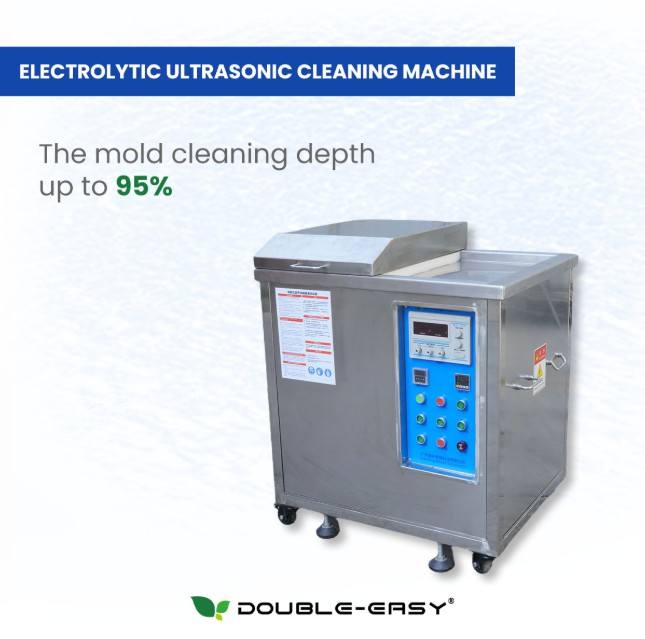
Standard ultrasonic cleaning has been a workhorse in industrial cleaning for decades. But as cleanliness standards tighten and production volumes rise, a more powerful hybrid technology has emerged: electrolytic ultrasonic cleaning .
The Cleanliness Gap
Side-by-side comparisons reveal a striking difference. Electrolytic ultrasonic cleaning achieves a fundamentally higher level of cleanliness. The electrolytic action not only removes surface oils but also chemically reduces thin oxide layers, leaving a chemically active metal surface that promotes superior results. Parts emerge with a clean, bare-metal appearance—often described as 'restored to their original steel color' .
In electroplating operations, this difference translates directly into reject rates. Facilities using standard ultrasonic cleaning alone often report 5–15% plating defects related to inadequate pre-cleaning. Those that have integrated electrolytic ultrasonic cleaning consistently report defect rates below 1% .
What Standard Ultrasonic Can't Do
Standard ultrasonic cleaning relies entirely on cavitation—the formation and implosion of microscopic bubbles. While effective for loose contaminants like machining oils and dust, it struggles with:
Baked-on carbon deposits – High-temperature residues that bond to surfaces
Oxide layers – Chemical bonds that require more than mechanical force
Blind holes and complex geometries – Cavitation cannot penetrate trapped air pockets
Tenacious machining oils – Contaminants that resist simple cavitation
How Electrolytic Ultrasonic Bridges the Gap
Electrolytic ultrasonic cleaning combines the mechanical force of cavitation with the chemical action of electrolysis. The process works like this: the metal workpiece is submerged in a specialized cleaning solution and connected as an electrode. A low-voltage direct current is applied, generating microscopic hydrogen and oxygen bubbles directly at the metal surface. These bubbles physically lift contaminants away, while the electrolytic reaction chemically breaks down oils, oxides, and carbon residues .
Meanwhile, the ultrasonic transducers continue generating cavitation throughout the tank. The combination is synergistic: electrolysis loosens what cavitation then shears away. Contaminants that would resist standard ultrasonic cleaning—stubborn carbon deposits, baked-on oxides, tenacious machining oils—are stripped away completely .
Material Compatibility Considerations
Electrolytic ultrasonic cleaning works excellently on steel-based materials (tool steel, stainless steel, carbon steel). However, it is generally not suitable for copper, brass, or aluminum, which may be attacked during electrolysis . For these materials, consult your supplier for specialized electrolyte formulations.
The Yizai Difference
Guangzhou Yizai Intelligent Technology Co., Ltd. has been at the forefront of electrolytic ultrasonic technology since 2017. Our machines feature digital control panels that allow operators to precisely set current density, ultrasonic frequency, and cycle times . We hold 3 independent invention patents and 9 utility model and software copyright patents .
Our equipment integrates Mitsubishi PLC and touchscreens, Schneider power supplies, Keyence flowmeters, and Grundfos pumps—components chosen for durability and precision performance.
Located in Huadu District, Guangzhou—just 5 km from Baiyun Airport—we serve customers worldwide with fast logistics and responsive technical support.
If your reject rates are higher than they should be, if plating adhesion is inconsistent, or if you are spending too much time on rework, the gap between 'clean' and 'electrolytically clean' may be exactly where your solution lies .
/Electrolytic-Ultrasonic-Cleaning-machine-PG10538050



 WhatsApp
