繁体中文
 English
 VietNam
 Русский
 日本語

Every laser cleaning purchase comes down to a fundamental question: do you need flexibility, or do you need throughput? The answer determines whether a handheld unit or an automated cell is right for your operation—and getting it wrong means wasted capital or missed productivity.
The case for handheld laser cleaning
Handheld systems put the laser where the work is. Modern units are compact enough for a single operator to carry, with cleaning guns weighing as little as 0.7–1.5 kg. They excel in situations where the part is too large to move, the geometry is unpredictable, or the job site is far from the factory floor.
Shipyards use handheld lasers to address corrosion on hulls and deck structures. Maintenance crews clean weld seams and flanges in place, without disassembly. Restoration specialists remove paint and oxidation from architectural metalwork with millimeter precision. The pulsed laser’s self-limiting behavior protects delicate substrates—when the beam reaches bare metal, reflection stops the cleaning action automatically .
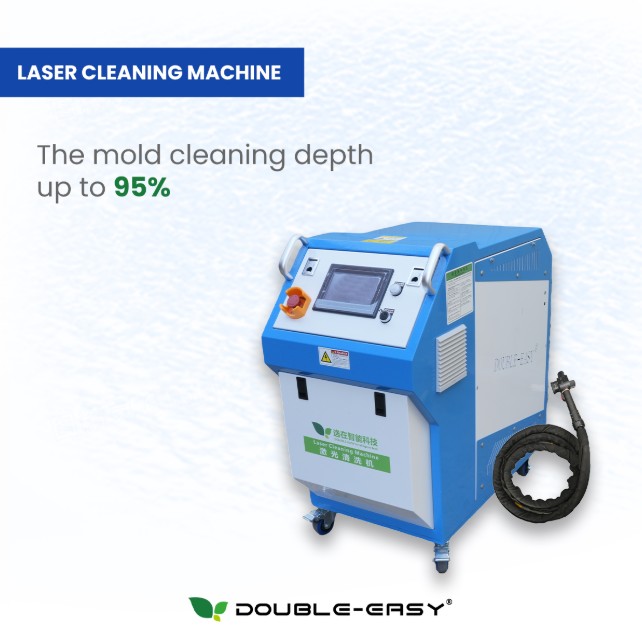
Power options range from 100W to 500W for most handheld applications. At the lower end, 100–200W systems handle light rust, mold cleaning, and small-part maintenance . Higher-power handheld units tackle thicker coatings and faster removal rates, but they require more careful parameter control to avoid heat buildup on thin sections.
When automation makes sense
Automated laser cleaning systems integrate the laser head with robotic arms, gantries, or conveyor lines. The value proposition shifts from flexibility to repeatability. Every part gets the same treatment: same power, same scan speed, same cleaning path, every cycle.
This matters in high-volume production. A robotic cell running continuously can replace multiple manual cleaning stations, eliminate variability, and operate without breaks. Laserax reported a nine-month payback on a 1.5kW robotic cell at a Canadian stamping plant that eliminated manual grinding . The economics are compelling when throughput is high and the cleaning task is consistent.
Automation also enables inline cleaning—the laser operates between manufacturing steps, preparing surfaces for welding or coating without interrupting the production flow. Medium-power systems in the 100W–1kW range are the default for these applications, balancing speed with substrate safety .
The hybrid reality
Many operations need both. A handheld unit for field work and oversized parts, plus an automated cell for repetitive production tasks. This combination covers the full spectrum without over-investing in either direction.
How Yizai helps you decide
Guangzhou Yizai Intelligent Technology Co., Ltd. does not sell one-size-fits-all equipment. Since 2017, we have worked with manufacturers to understand their actual workflows before recommending a configuration. Our engineers review part geometries, production volumes, and cleaning requirements, then propose the handheld, automated, or hybrid solution that fits.
Our laser cleaning machines are built with intelligent control systems, adjustable scan widths, and reliable fiber laser sources. We serve clients including BYD Auto, Foxconn, Toyota Engine, and Valeo—companies that demand both performance and support.
From our Huadu District headquarters, minutes from Guangzhou Baiyun Airport, we ship worldwide and provide remote technical assistance. Export accounts for 30% of our sales, with customers across Europe, America, and Southeast Asia.
The wrong configuration costs money. The right one pays for itself. Contact Guangzhou Yizai Intelligent Technology Co., Ltd. to discuss your application and get a recommendation grounded in real production experience.



 WhatsApp